Can AI Replace Employees? What to Hand It and What Stays With a Person
Every version of "will AI take my team's jobs" is really a question about specific tasks wearing a much bigger costume. Here's the honest split I use with clients: what I hand to AI without a second thought, and what still goes to a person, every time.
 By Abi Odedeyi · CodeFreeIQ
"Can AI replace employees" gets asked as if it has one answer that applies to a whole role. It doesn't. A role is a bundle of maybe fifteen different tasks, and some of those tasks are genuinely safe to hand over today while others never should be. The useful question isn't about the job title. It's about the task in front of you right now.
Stop asking about the role, start asking about the task
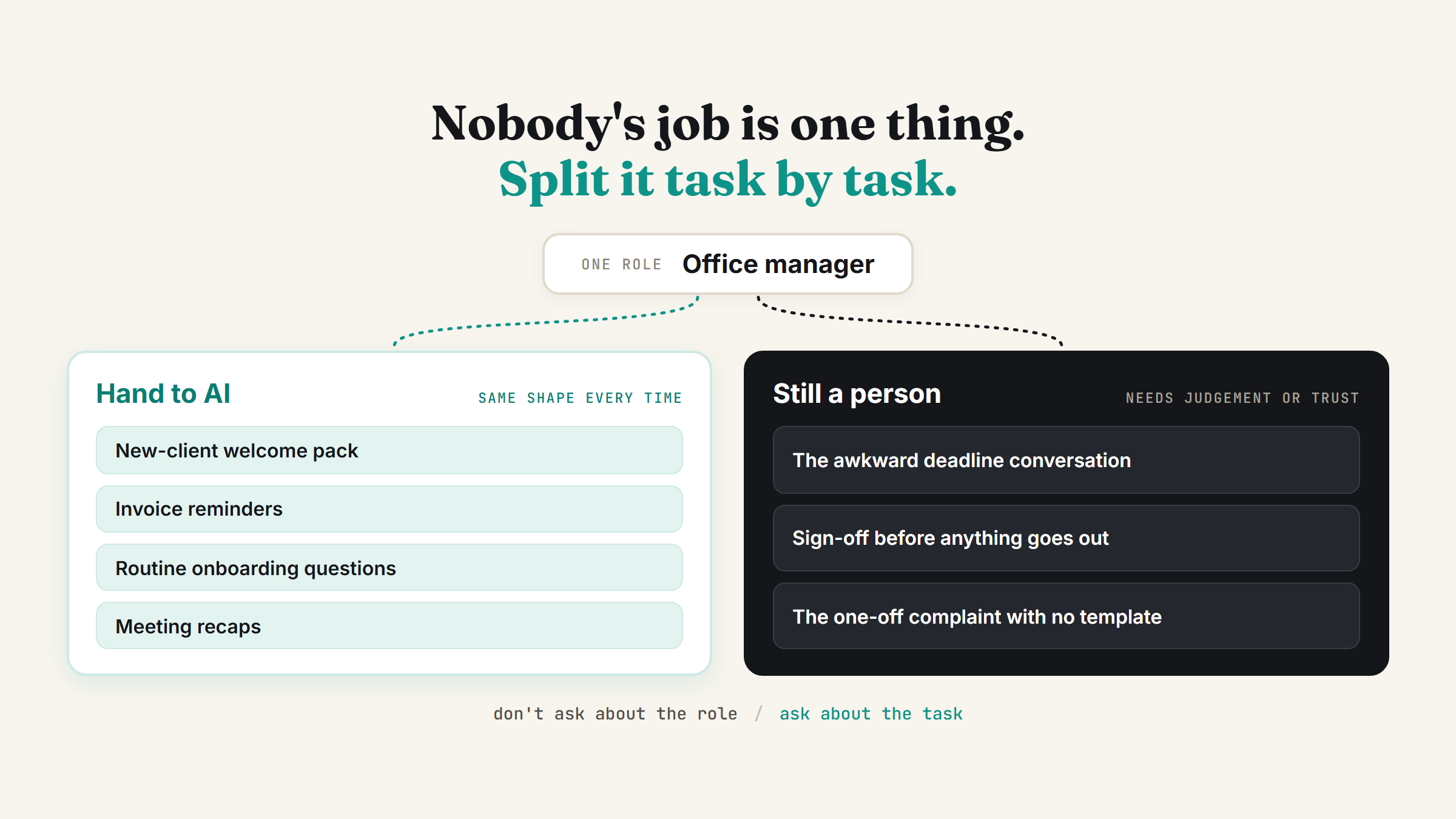
Nobody's job is one activity. An office manager's week is invoicing, scheduling, answering the same five questions from new hires, ordering supplies, and handling the one difficult situation that needs real judgement. Ask "can AI replace the office manager" and you get a useless yes-or-no. Ask "can AI draft the new-hire welcome email" or "can AI chase overdue invoices" and you get a clear answer in both directions.
That's the split I actually use with clients: go task by task, not role by role.
What I hand to AI without a second thought
Drafting anything repetitive. Welcome emails, invoice reminders, meeting recaps, the first pass of a status update. These follow the same shape every time, which is exactly what AI is built to do well.
Sorting and summarising. An inbox that needs triaging into Action Required, Waiting On, and Reference before anyone opens it. A pile of call notes that needs turning into a one-page brief. Pattern-matching across text at volume is a genuine strength, not a party trick.
First-pass research. Pulling together what's publicly known about a prospect before a call, or drafting a comparison of two tools against a brief. It still gets checked, but starting from a draft beats starting from nothing.
If you're not sure which of your own team's tasks fit that shape, the three-question test in what to automate first is the same filter: repetitive, high-volume, and not dependent on someone's specific judgement.
What still goes to a person, every time
Anything that needs a relationship, not just information. A difficult conversation with a client who's unhappy, a performance conversation with a team member, the judgement call on whether to push back on a request or let it go. These depend on context and trust that built up over months, not on a pattern in text.
Final sign-off on anything that leaves the business. A draft is fine from AI. The decision to actually send it, publish it, or put the company's name on it stays with a person. That's not caution for its own sake, it's the one habit that keeps a mistake from reaching a customer before anyone's seen it.
Judgment calls with no repeatable pattern. Deciding how to handle a one-off complaint that doesn't fit any template, or which of three strategic directions to take the business. AI can lay out the options. It shouldn't be the one deciding.
A fictional example: the same role, split in half
Picture a five-person agency's office manager. Before, her week included drafting the new-client welcome pack, chasing three or four overdue invoices, answering the same onboarding questions from new hires, and the occasional awkward conversation about a missed deadline. Now, Claude drafts the welcome pack and the invoice reminders from a template she set up once, and answers the routine onboarding questions through a connector to the team's shared docs. She still reviews every invoice reminder before it sends, and the awkward deadline conversation never went anywhere near AI. Her week didn't lose a task that mattered. It lost the three that were eating her Monday mornings.
That pattern, drafting and sorting handed over, judgement and relationships kept, is the same one behind how to hire an AI employee: a narrow job description, real tool access, and a human checkpoint before anything goes external.
The checkpoint is what makes this safe to scale
Every task I hand to AI that could reach someone outside the business keeps a human checkpoint, no exceptions. That's the difference between a tool that quietly saves hours and one that causes a problem the first time it hits something it wasn't set up to handle. I've written about why that checkpoint matters and where it breaks down in do AI employees actually work: the short version is that scope and review, not the AI itself, decide whether something holds up past the first week.
Where to start if you're deciding this for your own team
Don't start by asking which roles are "at risk." Start by listing what a specific person actually does in a normal week, then run each task through the test above: repeatable, or judgement-dependent? Internal, or does it reach a customer? A free AI time audit is the fastest way to get that list honestly instead of guessing from memory, and it's usually the first thing that makes the split obvious.
If you want a straight answer on which tasks on your team are actually safe to hand over, book a strategy call and we'll go through the real list, not a generic one.
FAQ
Can AI really replace an employee's job?
Not the whole job, in almost every case. A role is a bundle of different tasks, and AI can reliably take over the repetitive, pattern-based ones: drafting, sorting, summarising, first-pass research. The tasks that depend on judgement, relationships, or final sign-off on anything external still need a person.
Which tasks are safest to hand to AI first?
The ones that are repetitive, happen often, and don't need your personal judgement to get right: drafting routine emails, sorting an inbox, summarising notes, producing a first pass of a recurring document. What to automate first covers the exact test to run before handing anything over.
What should never go to AI without a person checking it first?
Anything that leaves the business and reaches a customer, client, or the public. A draft is fine. The decision to send, publish, or put your name on it should stay with a person until you've watched the AI get it right consistently over weeks, not one good demo.
Does handing a task to AI mean losing the role entirely?
Not in what I've seen built for clients. The roles that keep their shape are the ones where the repetitive parts get handed off and the judgement and relationship parts stay. The person's week gets shorter on the tasks that were eating time without adding value, not the ones that actually needed them.
Want to know which roles on your team are actually safe to hand to AI?
Book a strategy call and I'll go through your team's real tasks with you, not a generic list of jobs "at risk."
Book a strategy call →One working AI system in your inbox, weekly
The Operator's AI: the email edition of everything I publish here, plus the Free AI Bundle the moment you join.
Subscribe free →