The Cowork Prompts I Actually Reuse Every Week
I don't improvise a new prompt every time I sit down with Claude Cowork. I reuse the same small set, because the ones that work twice in a row share a shape, and that shape is the actual skill, not the wording.
 By Abi Odedeyi · CodeFreeIQ
Most people open Claude Cowork, type whatever's in their head, and hope it lands. Sometimes it does. The problem is you can't tell, going in, whether today's version of that prompt will work as well as last week's, because the wording is different every time and so is the result.
I stopped writing new prompts from scratch a while ago. I reuse the same small handful, week after week, for the jobs that actually repeat: a content check-in, a client status update, a priorities pass on what's come in. The wording changes slightly each time. The shape doesn't. That shape, not the cleverness of any single sentence, is what makes a prompt worth reusing.
Why the same few prompts keep showing up
Most of my week isn't full of novel problems. It's the same handful of jobs on repeat: something needs summarising, something needs drafting, something needs checking before it goes out. A brand-new prompt for each of those is extra work with no payoff, because the job hasn't actually changed shape since last time. Once I noticed that, writing a reusable prompt once and adjusting only the specific detail each time became the obvious move.
This is the same instinct behind turning a recurring job into a proper Cowork skill: a skill is what you get when a reusable prompt is written up as saved instructions (sometimes with a script alongside) that Claude picks up on its own whenever the job comes round. A reusable prompt is the step before that, the one anyone can start doing today without building anything.
The shape that makes a prompt reusable
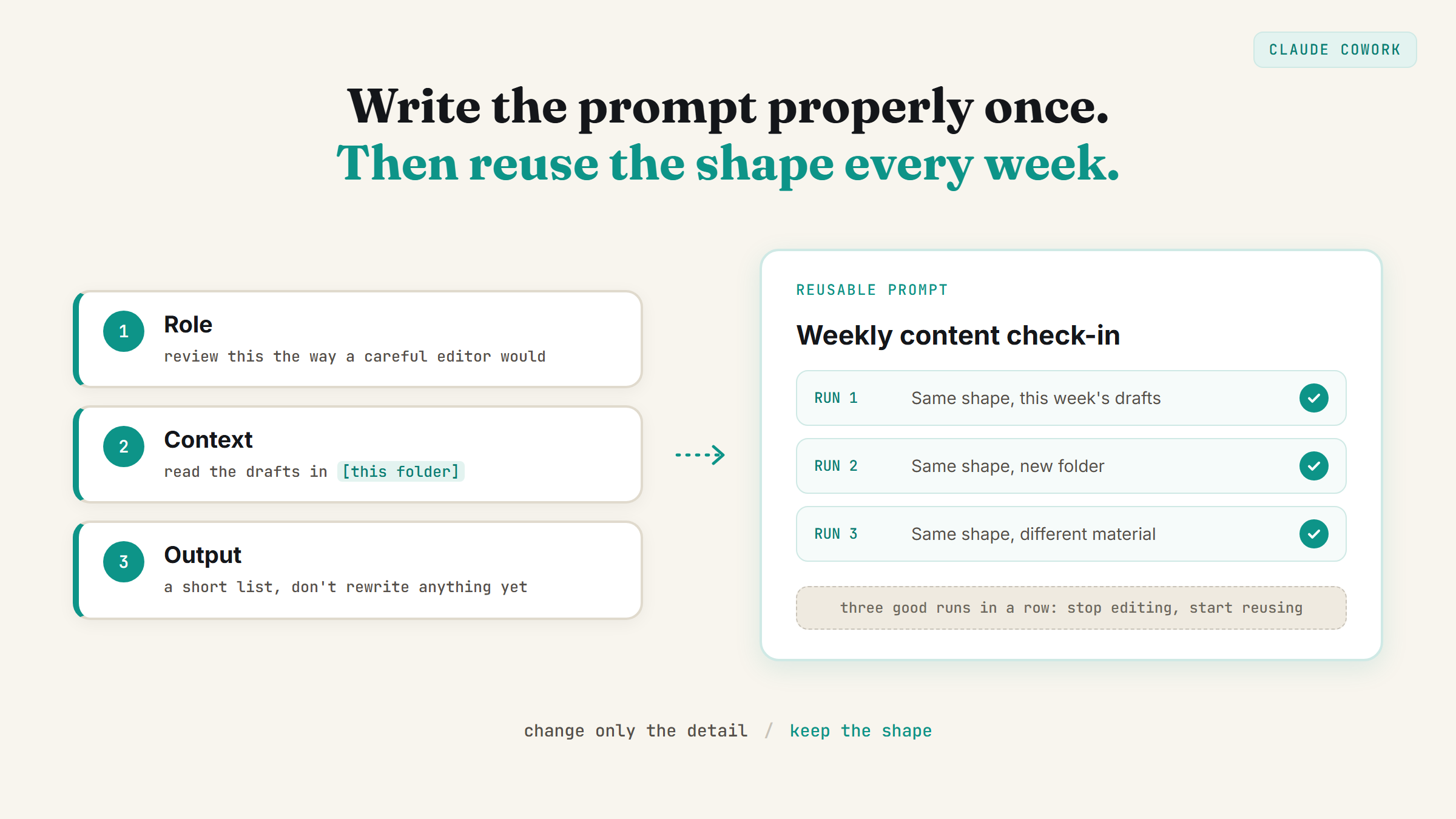
Every prompt I keep using has three parts, in this order: role, context, output.
Role tells Claude what seat it's sitting in for this task, not "you are an expert at everything" but something specific, like "you're reviewing this the way a careful editor would, not the way I'd read it myself." Context points at the actual material, a file, a thread, a named source, rather than describing it from memory and hoping the description is accurate. Output says exactly what shape the answer should come back in: a short paragraph, a table, a markdown file at a specific path, three bullet points and nothing else.
Drop any one of those three and the prompt stops being reusable. Skip the role and you get a generic answer that reads like it came from anyone. Skip the context and Claude is guessing at details instead of reading them. Skip the output shape and you get something different every time, which defeats the entire point of reusing it.
The weekly content check-in
The one I run most often is a check on whatever content is queued up for the week: does it match my voice, does it cross-link to the right resources, has anything crept in that I can't actually verify.
The "don't rewrite anything yet" line matters more than it looks. Without it, Claude will happily fix things on its own judgement, and I'd rather see the list of problems first and decide which ones are worth fixing.
The client status prompt
For anything client-facing, I use a version that forces a specific structure because a free-form update is the easiest place for something vague or half-true to slip through.
That last instruction is the one doing the real work. It tells Claude explicitly what to do with uncertainty instead of leaving it to guess, which is the difference between a status update I can send as-is and one I have to fact-check line by line first.
The priorities pass
This is the closest thing I run to a daily habit: a short prompt that turns whatever's piled up overnight into an ordered list instead of a pile.
None of this needs a script behind it. It's just a prompt I didn't have to rewrite this morning, because I wrote it properly once.
What actually makes a prompt worth keeping
A prompt earns a permanent spot once it's produced the same quality of result at least three times in a row. One good answer can be luck. Three in a row, on different source material, means the shape is doing the work, not the specific wording you happened to type that day. Below three, keep editing it. Above three, stop touching it and start reusing it as-is.
The other thing that makes reuse actually work is Claude remembering context between sessions, so you're not re-pasting the same background every single time you reuse a prompt. I covered how to set that up properly in giving Claude a permanent memory, and it's worth doing before you build out much of a prompt library, because without it every "reusable" prompt still needs the context rebuilt by hand each time.
If a prompt like one of these turns out to be something you're running on a fixed schedule rather than triggering by hand, that's the signal it's ready to become a scheduled Cowork task instead of something you start yourself every time.
If you're repeating the same request to Claude every week and rewriting it slightly each time, that's usually a sign it's ready to become a proper reusable prompt, or a skill. Book a strategy call and we'll turn your most repeated requests into something you don't have to rebuild from scratch again.
FAQ
What makes a Claude Cowork prompt reusable instead of a one-off?
A fixed shape: a role telling Claude what seat it's in, a pointer to the actual source material instead of a description of it, and an explicit output format. Change only the specific detail each time (which file, which project, which week) and keep the other three parts the same, and the result stays consistent run after run.
How is a reusable prompt different from a Claude skill?
A reusable prompt is text you type or paste, adjusted slightly each time, that you run by hand. A skill is what you get when that same job is written up as saved instructions, sometimes with a script alongside, that Claude loads on its own whenever the job comes up, so you stop pasting it in by hand. The prompt is the first step, the skill is what you build once the prompt has proven itself worth automating further.
How many times should a prompt work before I trust it as a reusable template?
Three times, on genuinely different source material, is a reasonable bar. One good result could be luck or an easy case. Three in a row, on different inputs, means the structure of the prompt is what's producing the result, not the specific details of that one request.
Do I need Claude's memory turned on for reusable prompts to work well?
Not strictly, but it changes how much you have to repeat yourself. Without memory, every "reusable" prompt still needs its background rebuilt by hand each time you use it. With memory on, Claude already has the context carried over, so the prompt only has to supply what's actually different about this run.
Want your own set of reusable prompts built around your week?
Book a strategy call and I'll help you turn your most repeated requests into prompts you can reuse without rewriting them from scratch every time.
Book a strategy call →One working AI system in your inbox, weekly
The Operator's AI: the email edition of everything I publish here, plus the Free AI Bundle the moment you join.
Subscribe free →