The Best AI for a Coaching Business (Run It, Don't Get Replaced by It)
Search for the best AI for a coaching business and you'll find two answers, neither useful. One sells you an AI clone that tries to replace the coaching itself. The other is a generic tool listicle with nothing specific to coaching. Here's what I'd actually set up.
 By Abi Odedeyi · CodeFreeIQ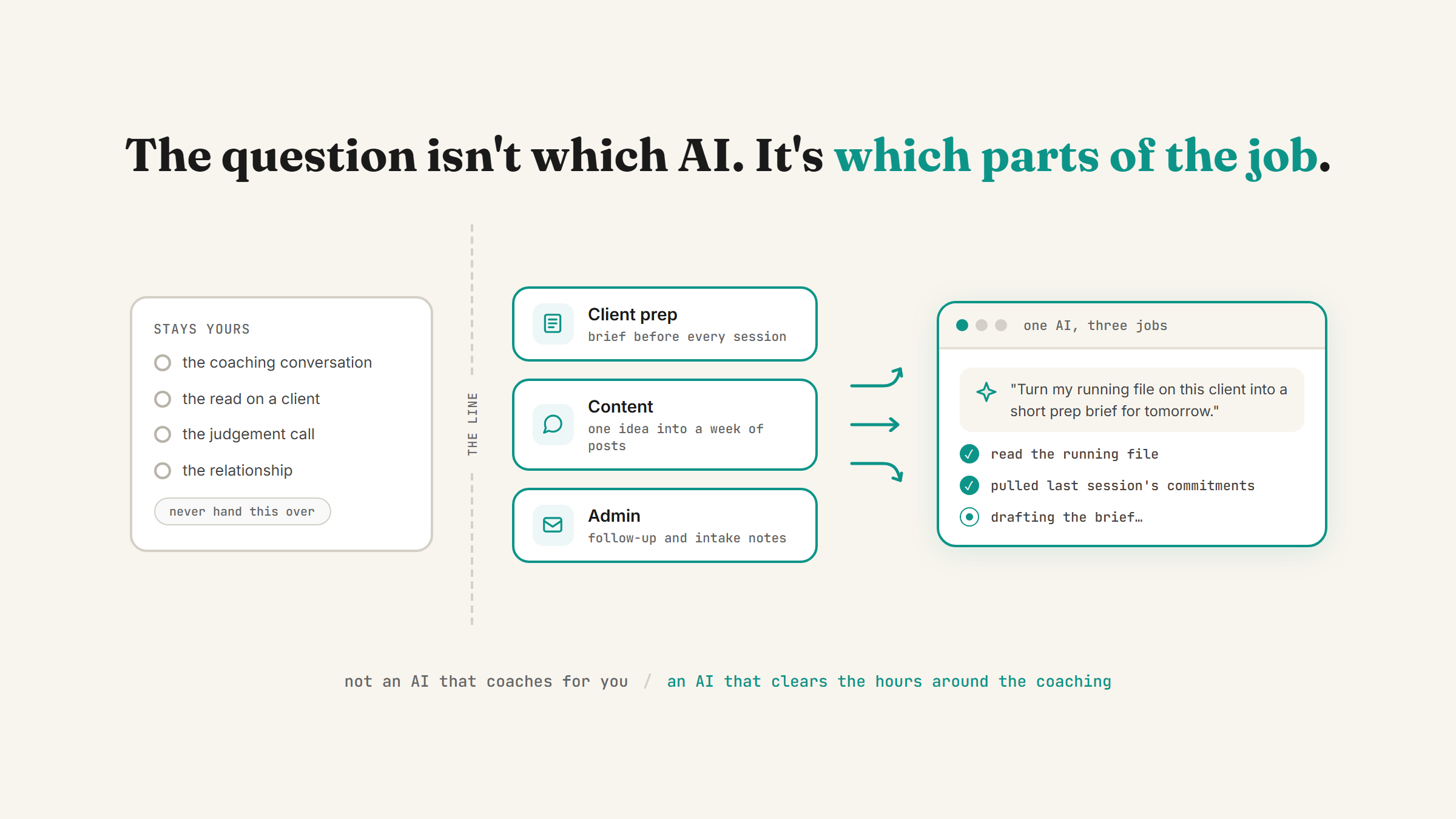
Search "best AI for a coaching business" and the results split two ways, and neither one is written for a coach actually running a practice. One camp is AI-coach clone platforms, tools that try to simulate the coaching conversation itself. The other is a generic "best AI tools" listicle that could apply to any business and mentions coaching nowhere. Neither answers the real question, which is narrower and more useful: which parts of running a coaching business should AI touch, and which parts should stay entirely yours.
The question isn't "which AI." It's "which parts of the job."
A coaching business is really two different kinds of work stitched together. There's the coaching itself, the conversation, the judgement, the relationship, the read on what a client actually needs in that session. And there's everything around it, the prep before a call, the notes and follow-up after, the content that brings new clients in, the admin that keeps the business running.
Only one of those halves should ever touch AI. The coaching stays yours. Everything around it is exactly the kind of repetitive, rule-based work AI is good at, which is also the same test I use for what to automate first in any business, not just a coaching one.
What should never go anywhere near AI
Be honest about this before you set anything up. The actual coaching conversation, live, in the room or on the call, is not a task to hand off. An AI-coach clone that tries to replace that conversation isn't saving you time, it's replacing the exact thing clients are paying you for. If a tool's pitch is "AI that coaches your clients for you," that's the tell to walk away, not the feature to buy.
Judgement calls about a client's specific situation belong to you too. AI can help you prepare for that judgement call. It shouldn't be making it.
Where AI actually earns its keep
Once the coaching itself is off the table, three areas reliably pay off for a coaching practice, and none of them are exotic.
Client prep. Before a session, a coach running Claude might pull together a quick brief: what came up last time, what the client said they'd try, what's changed since. That's a few minutes of prep that used to mean scrolling back through old notes, now it's a paragraph you read before the client joins the call.
Content. Coaches sell trust before they sell anything else, and content is how most people build that trust before a first call. Drafting posts, turning one idea into a week of content, or writing the follow-up email after a discovery call are all things AI does well once it has your actual voice to work from, not a generic tone. If you're short on raw material to turn into posts, turning one piece of content into a week's worth is the fastest way to stop starting from a blank page every time.
Admin and follow-up. The emails you send after every single session, the programme outline you rewrite slightly differently for every new client, the intake form you summarise before a first call. All repetitive, all rule-based, all a poor use of a coach's actual time.
A fictional example, to make this concrete
Fern Coaching, a fictional one-person leadership coaching practice, used to spend Sunday evenings writing that week's client prep notes from memory and old messages. Now the coach keeps a simple running file per client (what came up, what they committed to, what to check on next), and before each session asks Claude to turn that file into a short brief. The coaching itself hasn't changed at all. The two hours of Sunday prep is now closer to twenty minutes, and the notes are more consistent because they're pulled from the same file every time instead of memory.
That's the shape of what "AI for a coaching business" should actually mean. Not a tool that coaches for you. A tool that clears the two hours around the coaching so you can spend more of your week doing it.
Which AI, specifically
Most of what's above doesn't need a coaching-specific product at all. It needs a general-purpose AI tool used consistently for a few specific jobs, which is a different question to "which app is built for coaches." I laid out how Claude and ChatGPT actually differ for a small business owner in Claude vs ChatGPT for business, if that's the decision you're stuck on. The tool matters less than picking two or three real, repeated tasks and running them the same way every time.
Keep client details out of whatever you use
Coaching runs on private information, so this matters more here than in most businesses. What a client tells you in a session, their name, their situation, anything identifying, should never land in a prompt in a way that could resurface somewhere else. Before any client-related draft goes into an AI tool or out publicly, here's the exact check I run to keep that private. It takes a minute and it's worth building into the habit from day one, not after something slips.
Where to start
Don't try to set up client prep, content and admin all in the same week. Pick the one that's eating the most time right now, run it consistently for a couple of weeks, then add the next. If you're not sure which one that is, a free AI time audit of your actual week will show you exactly where the hours are going before you set anything up.
FAQ
What is the best AI for a coaching business?
There isn't one single best tool, the better question is which parts of running the practice AI should touch. A general-purpose tool like Claude, used consistently for client prep, content and admin follow-up, covers most of what a coaching business needs. The coaching conversation itself should stay with you, not any tool.
Can AI replace a coach?
No, not the actual coaching. The judgement, the read on a client, the relationship built session over session, that's the thing clients are paying for and it isn't a repeatable, rule-based task. AI can clear the admin and prep work around coaching so you have more time and attention for the sessions themselves, which is a different thing to replacing them.
Is it safe to use AI with client information as a coach?
Only if you keep identifying details out of it. Client names, specific situations, anything that could point to who a session was about, should be redacted or generalised before anything goes into a prompt or gets published. Here's the exact check to run before client-related work touches AI.
Where should a coach start with AI if they've never used it for their business before?
With one task, not everything at once. Client session prep and post-session follow-up emails are usually the fastest wins because they're repeated every week in roughly the same shape. Run a time audit first if you're not sure which task in your week is actually costing you the most.
If one of those three areas, client prep, content, or admin, sounds like where your week disappears, that's the one worth setting up first. Book a strategy call and we'll figure out the right setup for your practice specifically.
Want the AI setup that actually fits a coaching practice?
Book a strategy call and I'll help you work out which parts of your practice AI should touch, and which stay yours, then set it up properly.
Book a strategy call →One working AI system in your inbox, weekly
The Operator's AI: the email edition of everything I publish here, plus the Free AI Bundle the moment you join.
Subscribe free →