Can Claude Cowork Make Your Images? The Honest Answer, and What I Use Instead
People ask me this a lot: can you just tell Claude Cowork to "make me an image" the way you can with ChatGPT? The honest answer is no, not natively. Here's what's actually going on, and the route I use instead to get real, on-brand graphics out of Claude.
 By Abi Odedeyi · CodeFreeIQ
The question usually arrives in exactly these words: "Can I just tell Claude to make me a picture, the way I would with ChatGPT?" It comes up often enough that it's worth answering properly, in public, rather than one person at a time.
The honest answer: no, not natively
Claude doesn't have a built-in DALL-E or Midjourney style image generator you can simply ask for a picture from. It can read and understand images you upload, but asking it to "generate an image" the way you can in ChatGPT doesn't work the same way. Cowork is no different here, it's the same underlying model, just with more tools attached.
That catches people off guard because so much of what Claude does feels like magic once you've seen it build a working tool from a sentence, or sort a folder on its own. Images are the one obvious gap.
So how do all those AI-made graphics happen?
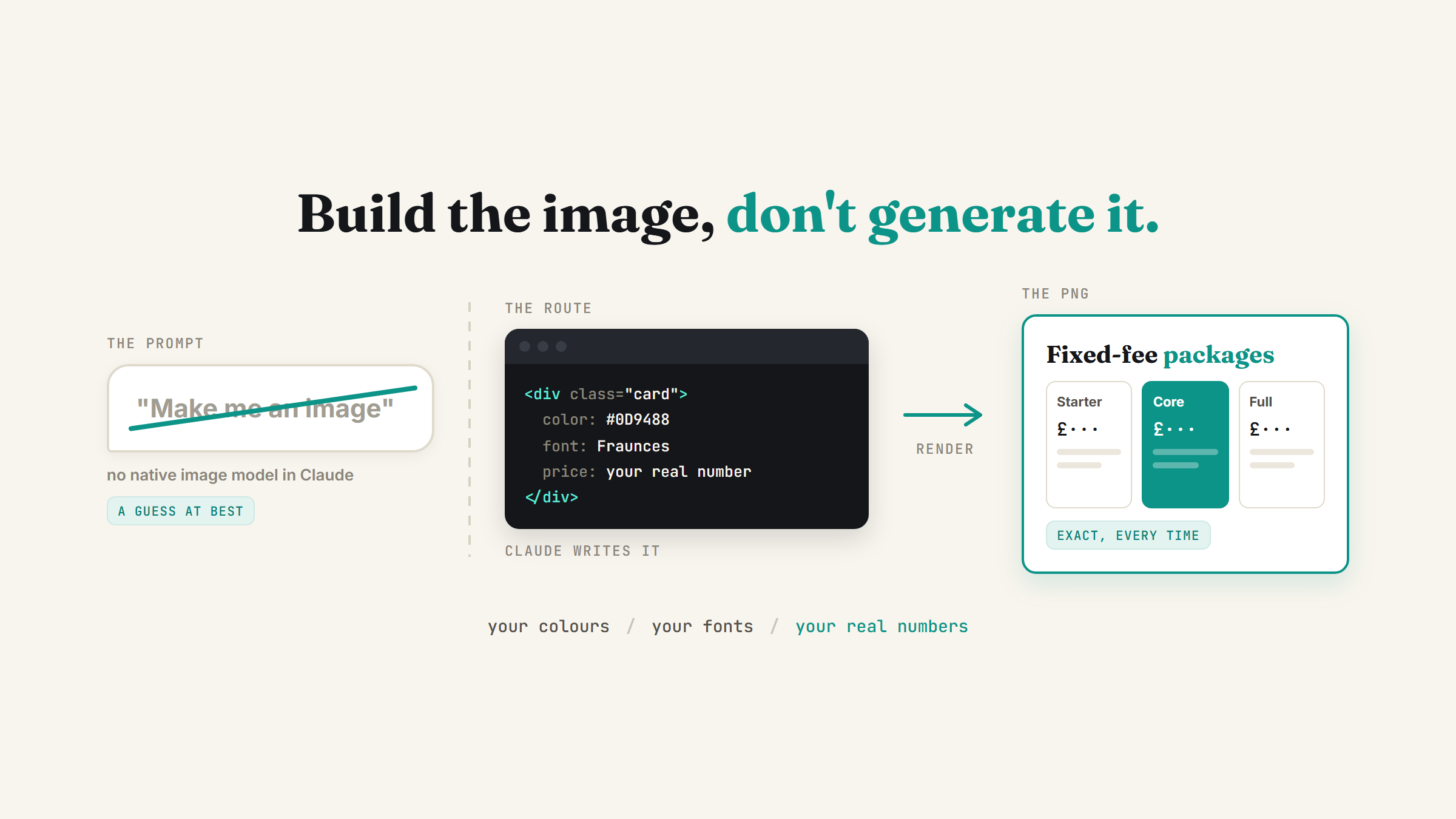
This is where it gets useful instead of disappointing. The way around the gap isn't a trick, it's a different route entirely: build the image as code, then render it. Instead of asking for a picture, you describe a layout in HTML and CSS (text, colours, shapes, a logo), and Claude writes that code for you. Then a separate step takes a screenshot of that code rendered in a browser, and that screenshot is your finished image.
This is exactly how most of the graphics on this blog get made. A hero image isn't generated from a text prompt, it's a small web page built to the brand's exact colours and fonts, then captured as a PNG. It's closer to hiring a very fast, very literal designer than asking an AI to dream something up.
Why this is actually the better route for a business
It would be easy to read "no native image generation" as a downside. For business use, the code route has a real advantage: it's exact, not approximate. A generated image is a guess at what you described. A coded one uses your actual brand colours, your actual logo, your actual numbers in a chart, every time, because you're not describing it, you're specifying it.
A fictional example: a four-person bookkeeping firm wants a simple graphic comparing their fixed-fee packages for a LinkedIn post. A generated image would approximate a table with roughly the right numbers. The code route puts their exact three price points, in their exact brand teal, in a layout that's identical every time they update it next quarter.
The trade-off is real too. This route depends on Claude running code, not just chatting. Cowork can do that, since it runs code in its own isolated workspace, and even a regular chat can save a chart as a PNG file. My own graphics pipeline runs in Claude Code on my laptop, because that's where my brand files and the rendering script live, so I can reuse them every time. Either way it's a step up from typing a sentence into a chat box, but nothing that needs you to learn to code yourself, you're still just describing what you want. If you haven't looked at where Code sits relative to Chat and Cowork, the three-levels breakdown is the place to start before trying this.
When you genuinely need a photo, not a graphic
None of this replaces an actual photograph. If you need a real picture of your product, your team, or your shopfront, the code route can't invent that for you, and nor can asking Claude to "generate" one, since it won't produce a convincing, honest photo of something that doesn't exist. For that, you still want a real camera, or a licensed stock photo, not an AI shortcut. The code-and-render approach is for diagrams, comparisons, quote cards, and branded graphics, the stuff that's really information wearing a nice layout, not photography.
If you're choosing between Claude and ChatGPT for this
This is one of the few places the two tools genuinely diverge. ChatGPT's native image generation is a real, mainstream feature, you type a prompt and get a picture back directly in the chat. Claude doesn't compete with that today. I cover this specific trade-off, and where Claude pulls ahead instead, in the full Claude vs ChatGPT comparison. If pictures from a prompt are your main use case, that's a point in ChatGPT's favour. If exact, on-brand, repeatable graphics matter more than a quick prompt, the code route is worth the extra step.
Once you've got one visual built this way, it becomes a repeatable asset rather than a one-off. I've written about the small, reusable skills that quietly run day-to-day work like this, building the graphic pipeline once and reusing it is the same idea applied to visuals.
If you've been avoiding AI for visuals because you assumed it meant generic, prompt-guessed graphics, that's the piece worth rethinking. Book a strategy call and I'll show you the actual pipeline behind the graphics on this site.
FAQ
Can Claude or Claude Cowork generate images from a text prompt?
Not natively. Claude can read and analyse images you give it, but there's no built-in feature that turns a text description into a generated picture the way ChatGPT's image generation does. The practical workaround for business graphics is building the visual as HTML and CSS code, then rendering that to an image, which is a different process entirely.
Why would I use code to make an image instead of just generating one?
Because it's exact rather than approximate. A generated image guesses at your brand colours, your logo, and your numbers. Coded graphics use the real ones every time, which matters for anything client-facing where consistency counts more than speed.
Do I need to know how to code to use this approach?
No. You do need Claude to run code for the rendering step, which Cowork does in its own workspace and Claude Code does on your own computer, but you still describe what you want in plain English. For the difference between Chat, Cowork and Code, this breakdown covers all three.
Is ChatGPT better than Claude for images because of this?
For quick, generated pictures from a prompt, yes, that's a genuine strength on ChatGPT's side. For exact, on-brand, repeatable business graphics (comparisons, quote cards, dashboards), the code-based route through Claude tends to hold up better over time, because it's not a fresh guess each time. I compare the two properly in Claude vs ChatGPT for business.
Want your own visuals built this way?
Book a strategy call and I'll show you the actual pipeline, HTML, brand colours, rendered to PNG, so your graphics look consistent instead of generic.
Book a strategy call →One working AI system in your inbox, weekly
The Operator's AI: the email edition of everything I publish here, plus the Free AI Bundle the moment you join.
Subscribe free →