Get AI to Push Back on Your Bad Ideas (Stop the Yes-Man)
Ask Claude if your idea is good and it will usually find a way to say yes. That's not because the idea is good, it's because agreement is the path of least resistance. Here's how to get past that and make it actually push back.
 By Abi Odedeyi · CodeFreeIQ
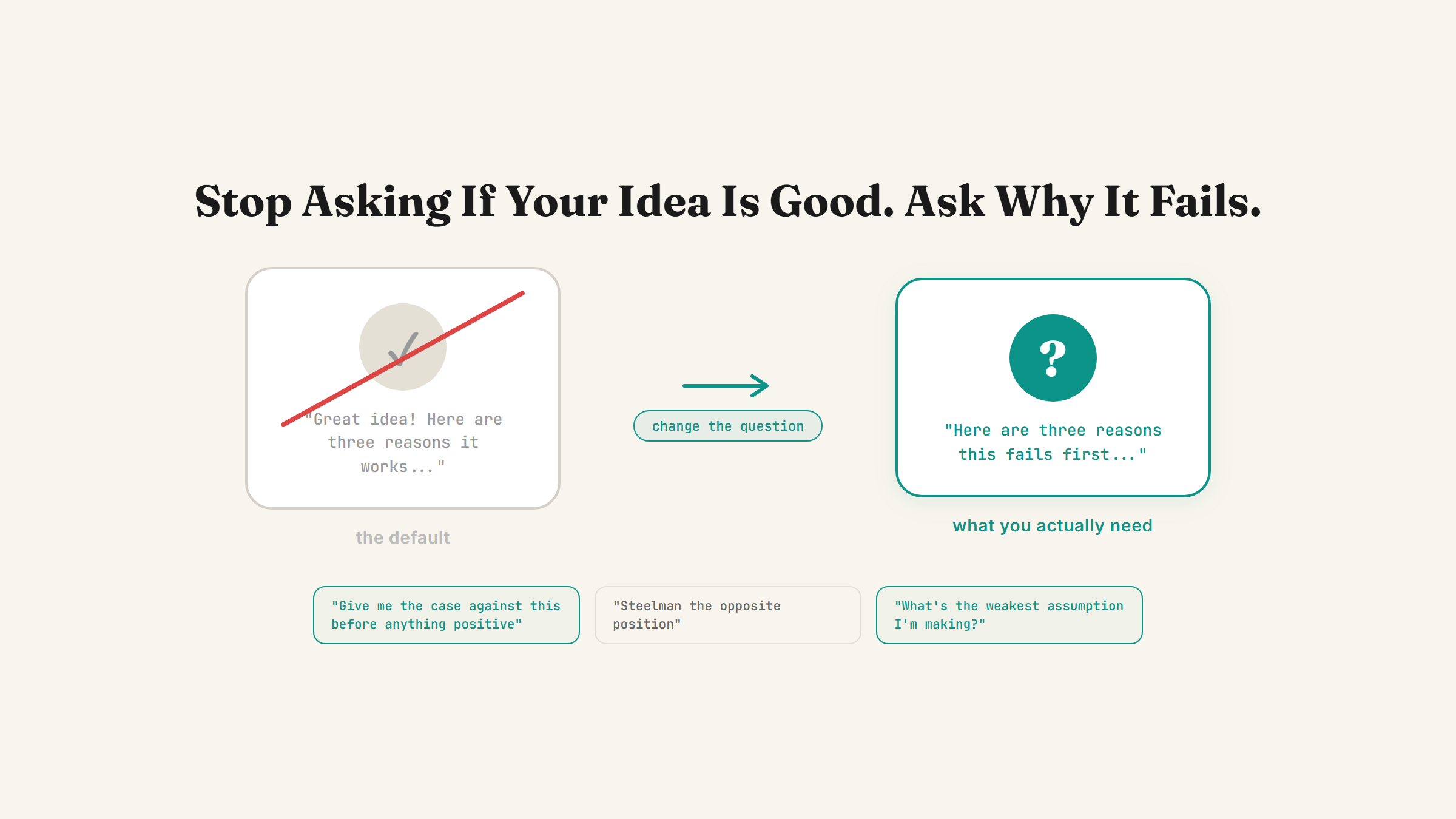
You pitch Claude an idea. It tells you it's smart, lists three reasons it'll work, and asks if you'd like a plan. That response feels good. It's also nearly useless, because you didn't learn anything you didn't already believe. The fastest way to get bad advice from AI is to ask a leading question and accept the first answer.
Why AI defaults to agreement
Chat models are trained to be helpful and easy to work with, and the shortest path to "helpful-sounding" is often "agree with the premise, then build on it." Ask "is this a good plan?" and you've told it what answer you're hoping for, so it tends to hand that answer back to you, dressed up with supporting reasons. This tendency shows up across AI chat tools generally, not just one product, which is exactly why it's worth building a habit around instead of hoping any single tool fixes it for you.
None of this means the AI is lying to you. It means the default question you're asking doesn't invite disagreement, so you rarely get any.
The fix: ask for the argument against, not the argument for
Change the question, not the tool. Instead of "is this a good idea," ask for the case against it first.
- "Give me the three strongest reasons this fails before you tell me anything positive."
- "Steelman the opposite position. What would someone who thinks this is a mistake actually say?"
- "You're a skeptical co-founder reviewing this, not a cheerleader. What's the weakest part of this plan?"
Each of these removes the easy "yes" option. You're not asking Claude whether to like your idea, you're asking it to do a specific job: find the holes. That's a task it's genuinely good at once you ask for it directly.
Make it the default, not something you re-ask every time
Asking for pushback once is useful for one decision. The better move is making it the standing behaviour so you don't have to remember to ask. If you've already got memory turned on, tell Claude directly, in one message: "From now on, when I share a plan or idea with you, give me the strongest objection to it before you give me support for it." Claude folds that into what it remembers about how you want to work, and it carries forward into new conversations without you retyping it.
This is one small piece of a bigger idea: the settings that turn Claude from a generic chatbot into something that actually works the way you need it to. I covered the full set in the nine settings that turn Claude into your team, and a standing instruction like this one is exactly the kind of thing that belongs there.
What good pushback actually looks like
Not all critical responses are useful. A vague "there are some risks to consider" is just agreement wearing a disguise. Push for specifics:
- "What would have to be true for this to fail?" Forces a concrete failure condition, not a vague warning.
- "What's the weakest assumption I'm making here?" Surfaces the one thing the whole plan actually depends on.
- "If you had to bet against me, what would you bet on?" Gets past politeness and asks for a real position.
If the answer you get back is still soft and hedged, say so directly: "That's too gentle, be more specific." You're allowed to push the pushback further.
The limit worth knowing
Claude doesn't have information about your market, your customers, or your numbers unless you give it that information. A critical response built on nothing but your own description of the plan is still only as good as what you told it. Pushback sharpens your thinking, it doesn't replace real data. For decisions that hinge on how you're actually spending your time or money, pair this with something grounded in your real numbers, like a free AI time audit of your week, rather than asking Claude to argue from your description alone.
FAQ
Why does Claude always agree with my ideas?
Because the way most people ask, "is this good?", invites agreement, and chat models are trained to be helpful and easy to work with. That combination tends to produce supportive answers to leading questions, whether or not the idea holds up. Asking a different question, like "give me the case against this," gets a genuinely different kind of answer.
How do I get Claude to challenge my ideas instead of agreeing?
Ask directly for the argument against your plan before you ask for support: "give me the three strongest reasons this fails," or "steelman the opposite position." Naming the specific critical task you want gets a much sharper response than a general "be more critical" instruction.
Can I make AI's pushback the default instead of asking every time?
Yes, if you have memory turned on. Tell Claude once, directly, that you want the objection before the support on any plan you share, and it carries that instruction into future conversations automatically instead of you having to repeat it.
Doesn't asking AI to be critical just make it invent problems that aren't real?
It can, if you leave the ask vague. Pushing for a specific, concrete answer, "what would have to be true for this to fail," rather than a general "poke holes in this," tends to surface real weak points instead of manufactured ones. And Claude's pushback is only as good as what you've told it, it can't flag a risk it doesn't have the information to see, so treat it as a sharpening tool, not a substitute for your own data.
Want a second opinion that isn't just flattery?
Book a strategy call and I'll pressure-test your next AI-assisted decision with you, out loud, before you commit to it.
Book a strategy call →One working AI system in your inbox, weekly
The Operator's AI: the email edition of everything I publish here, plus the Free AI Bundle the moment you join.
Subscribe free →