Can AI Write Your Employee Handbook? What It Gets Right and Where It Stops
Search for this and you'll land on a generator tool selling you a finished PDF in five minutes. That's not what actually happens when you use AI on a handbook. Here's the version I'd actually trust, and the parts I'd never skip a real review on.
 By Abi Odedeyi · CodeFreeIQ
Search "can AI write an employee handbook" and most of what comes back is a generator tool trying to sell you a finished PDF in five minutes. That's not a realistic answer, and if you've ever actually read a generated handbook against your own business, you already know why. The honest answer is narrower: AI is genuinely good at some of the work, and it should never be the last set of eyes on the rest of it.
The question isn't "can AI write it," it's "which parts"
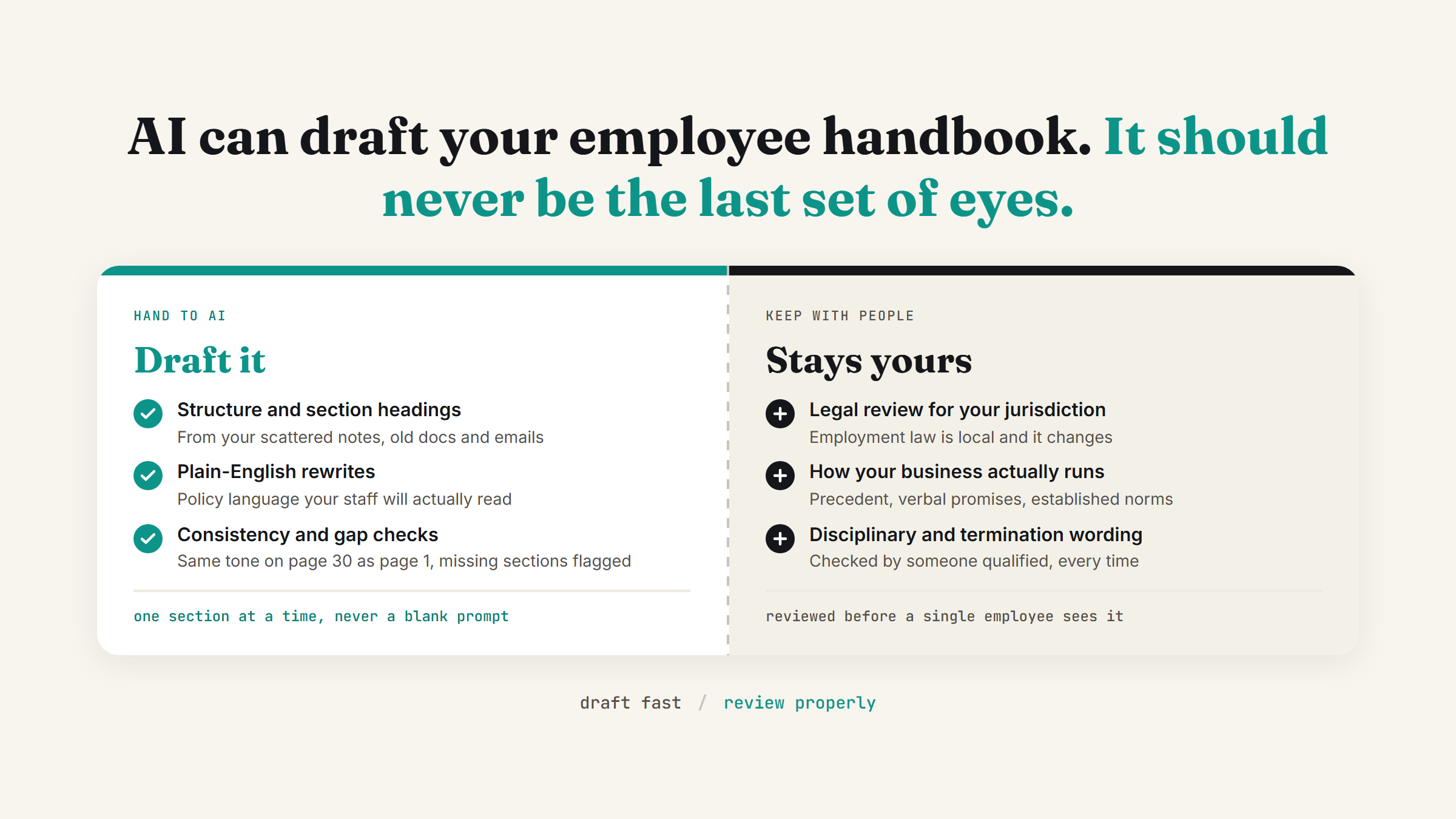
A handbook is really two different kinds of writing stitched together. There's the structure and the language, the section headings, the plain-English explanation of a policy, the consistent tone from one page to the next. And there's the content that has to be right for your specific business, your jurisdiction, and your actual practices, not a generic template's guess at them.
AI is strong at the first half and weak at the second. That split is the same test I use for what to automate first in any part of a business: hand off the repetitive, structural work, keep the judgement calls.
What AI actually gets right
Turning your existing notes into a readable first draft. Most small businesses already have policies, they're just scattered across old emails, a Google Doc from three years ago, and things you've told new hires verbally. Feeding that raw material to Claude and asking for a clean first draft, section by section, is a genuinely fast way to get from scattered notes to something reviewable.
Plain-English rewrites of anything that reads like legalese. If a policy is currently copied from a template and nobody in your business would explain it that way out loud, AI is good at turning it into language your actual staff will read and understand.
Consistency across sections. Tone, formatting, how each policy is introduced, whether every section ends with who to contact with questions. That's exactly the kind of repetitive check AI does well and a person doing it by hand tends to miss on page 30.
Spotting gaps against a checklist. Ask it to compare your draft against a standard handbook table of contents and flag what's missing (remote work policy, expenses, how disciplinary steps are communicated). It won't tell you if your policy is legally sound, but it's a fast, cheap first pass at completeness.
Where it stops, no exceptions
Legal compliance for your specific location. Employment law varies by country, and within a country often by state or region, and it changes. AI drafting from general training data does not know your jurisdiction's current requirements, and a wrong policy in a handbook is not a small mistake. This is the one place I would never skip a real review, from someone qualified to give that review, before a handbook goes to a single employee.
Your actual practices and precedent. A generic AI draft doesn't know how you've actually handled things before, what commitments you've made verbally to your team, or what's already an established norm in your business. If the handbook contradicts how things actually run, it creates a problem, not clarity.
Anything disciplinary, termination, or dispute-related. These sections carry the most legal and human weight in the whole document. Draft a first pass for structure if you want, but the actual wording here should be checked by someone qualified, every time, not spot-checked occasionally.
A fictional example, to make this concrete
Riverline Studio, a fictional 12-person design agency, had its handbook spread across a founding doc from four years ago and a handful of Slack messages nobody could find again. The founder fed the old doc and a rough outline into Claude, section by section: time off, expenses, remote work, how feedback and reviews work. What came back in an afternoon was a full structured first draft in plain language, consistent from section to section, something that would have taken a full week to assemble from scratch. Before anything went to the team, an employment lawyer reviewed the leave, disciplinary and termination sections specifically, the parts that actually carry legal risk. The AI draft didn't replace that review. It made the review faster, because the lawyer was checking a clean, organised document instead of untangling scattered notes.
The workflow I'd actually run
Feed it your real material first, never a blank prompt. Give Claude your existing policies, old docs, and a rough outline of what you want covered, and ask for a first draft section by section rather than the whole handbook at once. That keeps each section reviewable on its own instead of one long document nobody actually reads closely.
Read every section against how your business actually works, not just for typos. This is the step most people skip because the draft reads well, and it's the one that catches the gap between "sounds right" and "is actually true of us."
Send the legally sensitive sections to an actual qualified reviewer before anything goes to staff. Leave, disciplinary process, termination, anything touching local employment law. That review is not optional and AI does not replace it, however good the draft reads.
Keep this off the public record while it's a draft
A handbook in progress often contains details you wouldn't want to end up somewhere public, internal disciplinary language, salary bands, specific incidents you're writing policy in response to. The same check I run before any client-related draft goes into an AI tool applies here: here's exactly what I check before anything sensitive goes into a prompt. It's a minute of habit, worth building in from the first draft rather than after something ends up somewhere it shouldn't.
Where to start
Don't try to draft the whole handbook in one sitting. Start with the sections that are purely structural and low-risk, time off, expenses, how the day-to-day works, and get those drafted and reviewed first. Save the legally sensitive sections for last, once you know who's actually going to review them. If you're building this alongside other repetitive work in the business, how to hire an AI employee covers the same narrow-scope, human-checkpoint approach that makes a handbook draft safe to run this way.
FAQ
Can AI legally write an employee handbook on its own?
No. AI can produce a strong first draft of the structure and language, but employment law is specific to your jurisdiction and changes over time, so the legally sensitive sections, leave, disciplinary process, termination, need review from someone qualified before the handbook goes to any employee.
What parts of a handbook is AI actually good at drafting?
Structure, plain-English rewrites of policy language, consistency across sections, and spotting obvious gaps against a standard table of contents. It's weakest exactly where the stakes are highest: your specific legal obligations and your actual established practices.
Is it safe to put sensitive HR details into an AI tool while drafting?
Treat it the same way you'd treat any sensitive business data. Check what the tool does with anything you paste in, and avoid pasting specific incidents, salary figures, or anything identifying an individual employee. Here's the check I run before anything sensitive goes into a prompt.
How long does an AI-assisted handbook draft actually take?
The drafting itself can go from scattered notes to a structured first draft in an afternoon if you feed it real material section by section. The legal review afterward takes as long as it needs to, and that step shouldn't be rushed to match the speed of the draft.
If you're weighing whether to build this out properly or you're not sure which sections actually need a lawyer's eyes, that's exactly the conversation worth having before you start drafting. Book a strategy call and I'll walk through it with you.
Want a handbook draft that's actually ready for a lawyer to check, not a generic template?
Book a strategy call and I'll show you the exact workflow, what AI drafts, what stays yours, and where the review has to happen.
Book a strategy call →One working AI system in your inbox, weekly
The Operator's AI: the email edition of everything I publish here, plus the Free AI Bundle the moment you join.
Subscribe free →