Do You Need an AI Consultant? What One Actually Delivers for a Small Team
Anyone can call themselves an AI consultant right now, there's no license and no exam. That makes the question "do I need one" hard to answer honestly. Here's what a real engagement actually looks like for a small team, and the questions that separate it from someone reselling a subscription with a markup.
 By Abi Odedeyi · CodeFreeIQ
Anyone can call themselves an AI consultant this week. There's no license, no board exam, no minimum bar to clear. That's not a knock on the good ones, it's just the reason the question "do I need one" is genuinely hard to answer. The category includes people who'll spend two weeks mapping your actual workflows and building something that runs without you, and people who'll sell you a ChatGPT subscription with a 40% markup and call it a strategy. Here's how to tell which one you're looking at, and what a real engagement actually delivers.
What the job actually is, when it's done properly
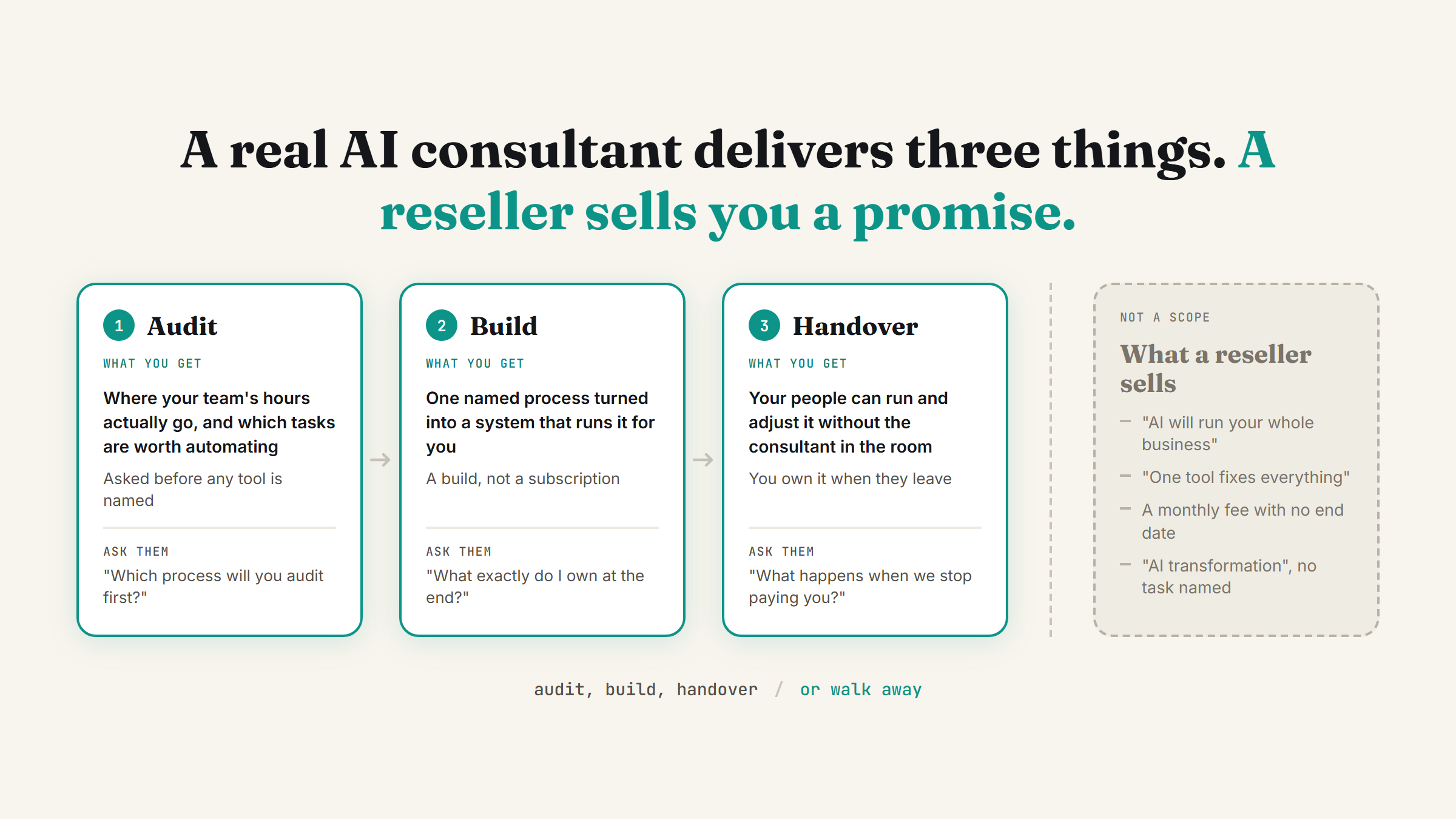
A real AI consulting engagement is a process audit first, and a build second. Not a tool recommendation. The useful version starts by looking at where your team's hours actually go: what's repetitive, what's high-volume, what needs a human's judgement and what doesn't. I wrote up the three-question test I use for that part, and it's the same test a good consultant should be running on your business before they suggest a single tool.
Only after that comes the build: the actual system, whether that's an email agent, an automated lead pipeline, or a Claude-based workflow that handles something your team currently does by hand. Then handover, so the system runs without the consultant sitting inside it forever.
The red flags that mean you're looking at a reseller, not a consultant
The tell is usually in what happens in the first meeting. If someone recommends a specific tool before they've asked a single question about your actual workflow, that's a reseller, not a consultant. A few other patterns worth watching for:
- Jargon instead of specifics. "AI transformation" and "leveraging automation" with no mention of which task, done by which person, currently taking how long.
- A subscription instead of a build. You end up paying monthly for access to a tool, not for a system that was actually built around your business.
- No handover plan. If the answer to "what happens when we stop paying you" is vague, the thing they built probably can't run without them, which means it isn't really yours.
- Promises with no boundary. "AI will run your whole business" is marketing, not a scope. A real engagement names the specific process it's automating and says plainly what's still on you.
Who genuinely needs one, and who doesn't
If you've already run your own audit and know exactly what to automate, you may not need outside help at all. Plenty of small teams can take a clear framework and a capable AI tool and build the first version themselves, that's true of a lot of what I write about on this blog. Where a consultant earns their fee is different: when nobody on the team has the time to map the workflows properly, when the build needs to plug into systems you don't want to learn from scratch, or when you've tried the DIY route and it stalled at "I don't know what I don't know."
A five-person business drowning in inbound enquiries it can't triage fast enough is a good candidate. A ten-person agency where the founder is confident and has an afternoon a week to spend is often better served by building it themselves first and hiring help only if that stalls.
What a real scope actually looks like
A properly scoped engagement names the process being audited, the system being built, who owns it after handover, and how it's priced, ideally against the value the system delivers rather than a flat day rate. If a proposal can't answer "what exactly do I own at the end of this," that's worth asking about before you sign anything, not after.
What this isn't
To be clear about the limits here: a consultant, done-for-you or otherwise, isn't a substitute for someone on your team who understands the business. The same split I described for consultants using AI in their own practice applies in reverse here: AI and the person who set it up can carry the scaffolding, but the judgement about your business stays with you. The best engagements end with your people able to run and adjust the system themselves, not permanently dependent on the person who built it. If an engagement is structured to keep you paying indefinitely for something that could have been handed over, that's worth questioning regardless of how good the initial build was.
FAQ
How much does an AI consultant cost for a small business?
It varies widely and depends on scope, so treat any number quoted without a specific process attached as a guess. What matters more than the headline figure is whether pricing is tied to a defined audit and build, or to an open-ended monthly retainer with no clear end point.
What's the difference between an AI consultant and just buying an AI tool?
A tool gives you access to a capability. A consultant (the real kind) maps your specific workflow first, then builds or configures something around it, and hands it over so it runs without them. Buying a tool alone leaves the mapping and the build as your job. If you'd rather do that part yourself, a time audit is a free way to start.
Can I just do this myself instead of hiring someone?
Often, yes. If you can find ninety minutes to audit where your team's time actually goes and you're comfortable working through a build with an AI tool, plenty of small teams get real results without outside help. Where it makes sense to bring someone in is when nobody has the time to do the mapping properly, or a DIY attempt has already stalled.
What should I ask before hiring an AI consultant?
Ask what specific process they'll audit first, what you'll own at the end, and what happens if you stop paying them. A consultant who can answer all three clearly, with a real scope rather than a vague promise, is worth taking seriously. One who can't is worth walking away from.
Want an honest read on whether you need one?
Book a strategy call and I'll tell you straight, based on what you're actually dealing with, whether this is a DIY job or worth paying someone to do properly.
Book a strategy call →One working AI system in your inbox, weekly
The Operator's AI: the email edition of everything I publish here, plus the Free AI Bundle the moment you join.
Subscribe free →