Can AI Replace Coaches? What It Handles and What It Never Will
Every coach asking "will AI replace me" is really asking two different questions at once. Here's where AI genuinely takes work off your plate, and where it has no business being anywhere near the coaching itself.
 By Abi Odedeyi · CodeFreeIQ
"Will AI replace coaches?" gets asked like it has one answer. It doesn't, because it's actually two separate questions wearing one sentence: can AI do the admin around coaching, and can AI do the coaching. The answer to the first is yes, most of it. The answer to the second is no, none of it. Mixing the two up is where people either panic for no reason or hand off the wrong thing.
The admin question and the coaching question aren't the same question
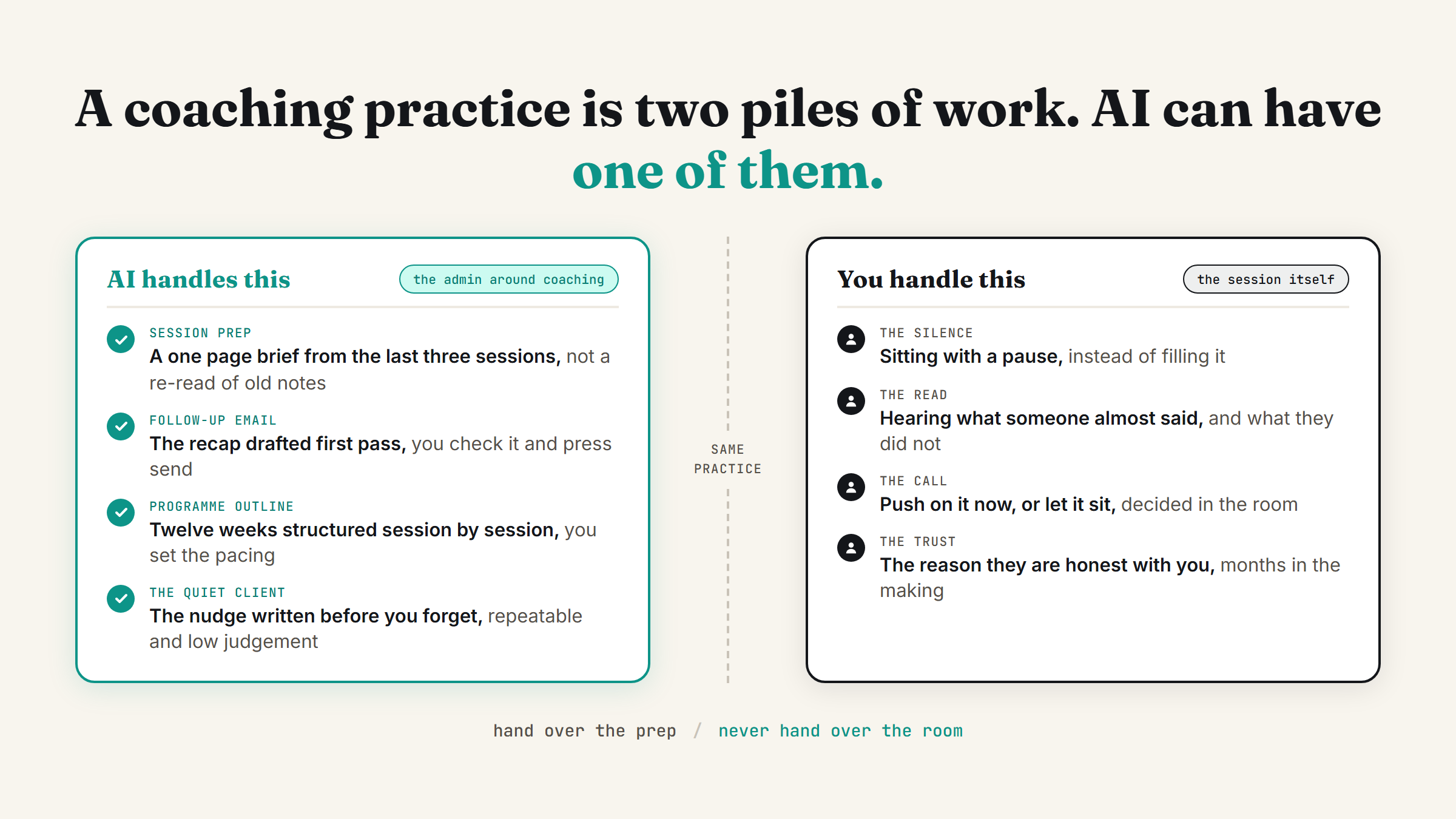
Everything a coach does splits into two piles. One pile is preparation and follow-through: reading notes before a session, drafting the recap after, writing the programme outline, chasing a client who's gone quiet. The other pile is the session itself: the questions, the silences, the read on whether someone actually believes what they just said out loud. AI is genuinely useful on the first pile. It has no place in the second.
The confusion happens because both piles get called "coaching work." They aren't the same skill, and they don't need the same tool.
What AI actually handles well
Session prep is the clearest win. Before a call, a coach can hand Claude the last three sessions' notes and ask for a one-page brief: what this client committed to, what's likely stalled, and two or three questions worth opening with. That's pattern-matching across text, which is exactly what AI is built for, and it turns fifteen minutes of re-reading old notes into two minutes of reading a summary.
Follow-up emails are the second. The recap that goes out after a session, summarising what was covered and what the client agreed to do before the next one, is a template with different details each time. That's a five-minute draft for AI to get right on the first pass, leaving the coach to check it and press send rather than start from a blank page.
Programme outlines are the third. Structuring a six-week or twelve-week programme around a client's stated goal, session by session, is a drafting task before it's a judgment task. AI can produce a reasonable first pass in minutes; the coach still decides whether the pacing is right for this specific person, which is the part that actually needs the years of experience.
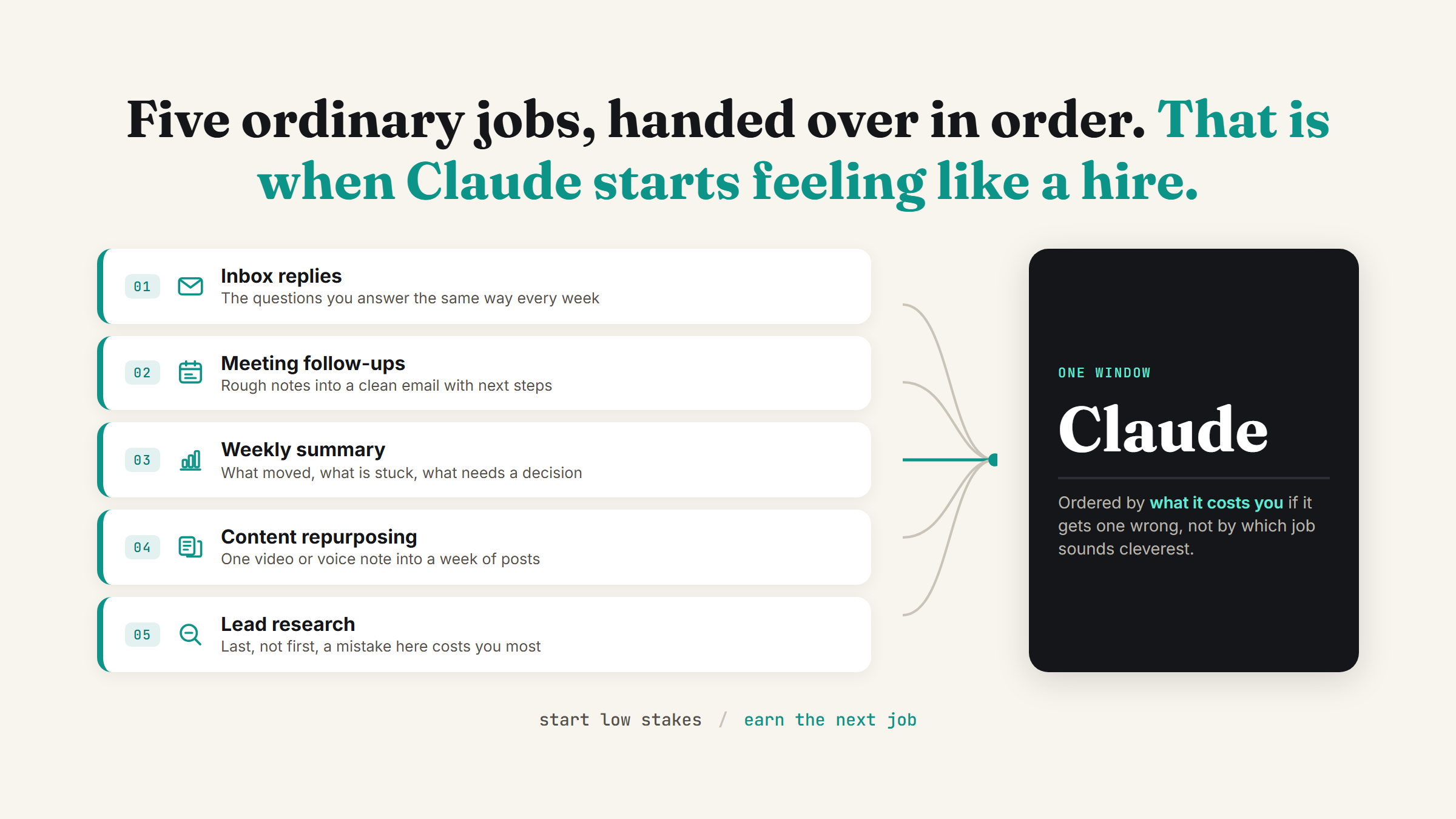
If none of that sounds like it fits your week yet, this is the framework I use to decide what's actually worth automating first: the same test, is this repeatable and low-judgment, applies here.
Where it falls apart completely
None of that touches the actual session, and it shouldn't. Coaching is built on things AI cannot do: sitting with a silence instead of filling it, hearing what someone almost said, deciding in real time whether to push on something or let it sit, and building the kind of trust where a client will actually be honest. Those aren't tasks with a repeatable pattern behind them. They're judgment calls made in the room, informed by a relationship that took months to build.
A coach who hands the pre-session brief to AI and walks in more prepared is using it well. A coach who tries to have AI suggest what to say in the room has misunderstood what the client is actually paying for.
A fictional example: what changed and what didn't
Picture a leadership coach running eight clients a month. Before, she spent Sunday evenings re-reading notes for Monday's sessions and Monday nights writing recap emails, roughly four hours a week that had nothing to do with actually coaching anyone. She now has Claude draft the pre-session brief from her raw notes and a first-pass recap email after each call. She still reads every brief, edits every email before it goes out, and the sessions themselves haven't changed at all. What changed is that Sunday evening is free, and Monday's sessions start from a sharper brief than she used to write herself.
The privacy line coaches cross without noticing
Session notes are some of the most sensitive text a coach handles, and it's easy to paste a real name, a real situation, or a detail specific enough to identify someone straight into a prompt without thinking about it. Before any client note goes into AI for a prep brief, it's worth running the same check I use on client-facing drafts: swap names for generic descriptions, round or remove identifying details, and only proceed once nothing in the text could point back to a specific person. I built this as a free skill you can install so it happens automatically instead of relying on remembering to do it every time.
The same instinct extends to setup: if you're tired of re-explaining your programme structure or your voice to AI every single time, giving it a permanent memory means you only set that context once.
Where to actually start
Don't hand AI your whole practice in one afternoon. Pick the single admin task that eats the most time every week, whether that's session prep, follow-up emails, or programme outlines, and set that one up first. If you're not sure which task that is, a free AI time audit of your week will show you exactly where the hours are actually going before you guess. Once you know which task to hand over, the best AI for a coaching business covers which tool to actually use for it.
FAQ
Can AI actually replace a coach?
No. AI can draft the admin around coaching, session prep briefs, follow-up emails, and programme outlines, but it cannot hold a real coaching session. Reading a client's silence, deciding whether to push on something, and building trust over time are judgment calls made in the room, not text-generation tasks.
What parts of a coaching practice are actually safe to automate?
The repeatable, low-judgment parts: turning raw session notes into a one-page prep brief, drafting the post-session recap email, and producing a first-pass programme outline for a new client's stated goal. The coach still reviews and edits all three; AI just removes the blank-page problem.
Is it safe to put client session notes into AI?
Only after removing anything that identifies the client: names, company details, and any specifics detailed enough to point back to one person. Round or generalise sensitive details before they go into a prompt. The Redaction Kit automates this check so it happens the same way every time instead of depending on memory.
How much time does this actually save a working coach?
It depends on caseload, but session prep and follow-up emails are usually the biggest chunk: re-reading notes and writing recaps for eight to ten clients a month can easily run three to four hours. Handing the first draft of both to AI, while still reviewing everything before it goes out, is usually where coaches see the fastest time back. A time audit will show you the real number for your own week rather than a guess.
If admin is the part of your practice you keep putting off, book a strategy call and we'll work out what's actually safe to hand off first.
Want your coaching practice's admin handled properly?
Book a strategy call and I'll help you work out which parts of your practice are safe to hand to AI, then set the first one up live.
Book a strategy call →One working AI system in your inbox, weekly
The Operator's AI: the email edition of everything I publish here, plus the Free AI Bundle the moment you join.
Subscribe free →