Will AI Replace Consultants? What I See Training Them on It
Every consultant I train asks some version of the same question eventually. Here's the honest split between what AI already does for the job and what it still can't.
 By Abi Odedeyi · CodeFreeIQ
I train consultants on AI, so this question comes up in nearly every session. Usually it arrives as a joke that isn't really a joke. Someone will ask, half laughing, whether they're training their own replacement.
The honest answer is that the question is the wrong shape. AI isn't going to replace consultants as a category. But it is already doing a real slice of what consultants get paid for, and pretending otherwise wastes the time you could spend deciding what to hand off.
The part AI already does well
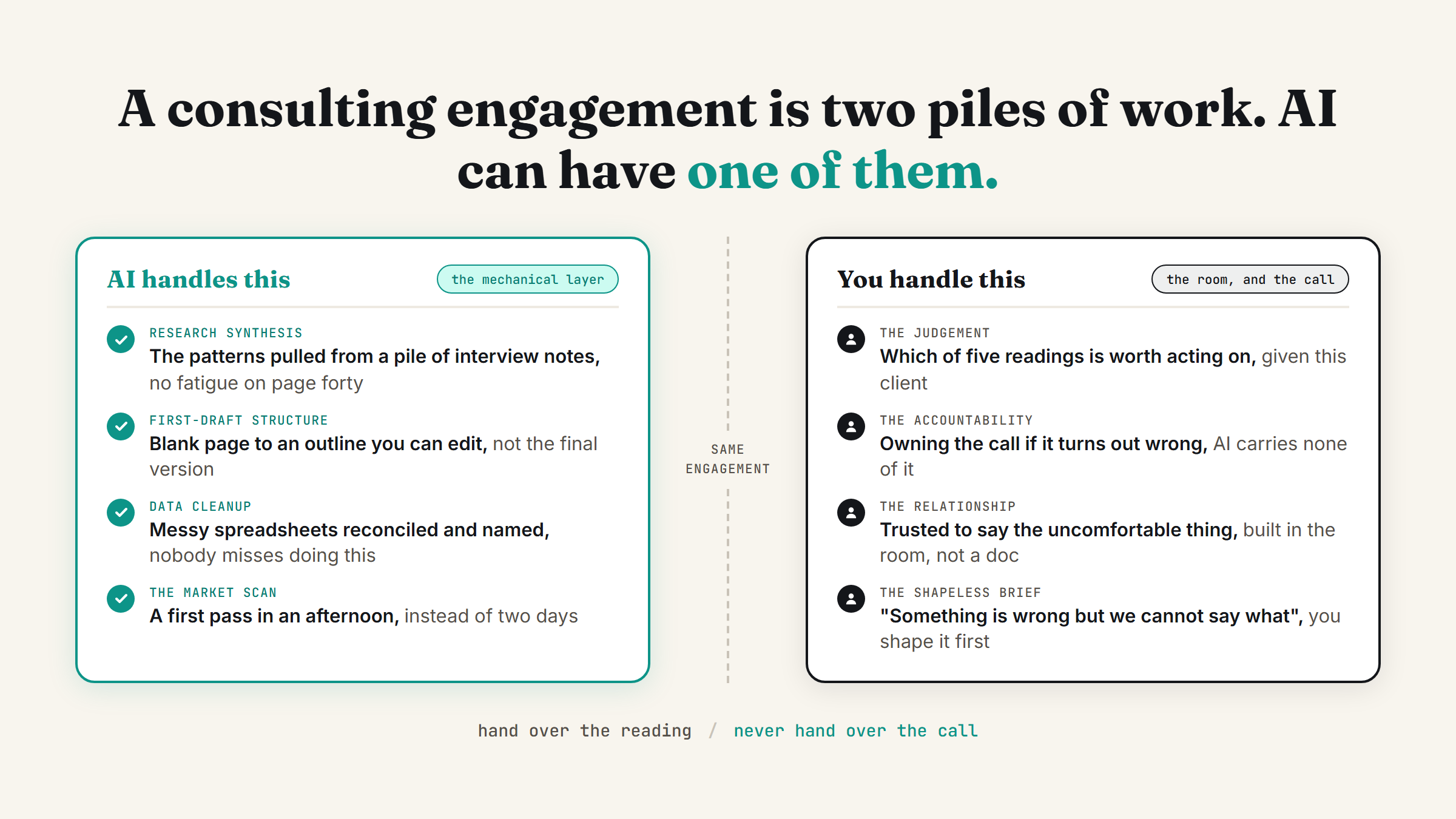
Research synthesis is the clearest win. Feed it a pile of interview notes, market reports, or competitor material and ask for the patterns, and it will find them faster than a person reading the same pile cold. Not because it's smarter, but because it doesn't get tired on page forty of a PDF.
First-draft structure is close behind. A rough outline for a deliverable, a first pass at a slide narrative, a summary memo pulling together what a week of interviews turned up, AI gets you from blank page to something you can actually edit. That's a different task from writing the final version, and treating it as the final version is where quality slips.
Data cleanup and formatting is the unglamorous third. Reconciling messy spreadsheets, standardising naming across a dataset, turning a wall of notes into a structured table. It's real time back, and almost nobody misses doing it by hand.
The part it doesn't touch
Judgment under ambiguity is still yours. A consultant's real job is often deciding which of five plausible interpretations of messy data is the one worth acting on, given a specific client's politics, constraints, and appetite for risk. AI can lay out the options. It can't own the call, because it doesn't carry the accountability if the call is wrong.
The relationship is the product, not the deliverable. Clients hire a consultant they trust to tell them something uncomfortable and be right about it. That trust gets built in the room, over time, not in a document. No amount of AI-assisted drafting changes who the client picks up the phone to.
Structuring an ambiguous problem from scratch is the hardest thing consultants do, and it's the part AI is weakest at. Give it a well-defined question and it's fast. Give it "our board is worried about something but can't articulate what" and it needs you to shape the problem before it can help with it at all.
What I actually see, training consultants on this
Take a fictional example: a small strategy shop I'll call Ridgeline Advisory, three partners, no research staff. Before, a market scan for a new engagement ate two days per partner. Now one partner runs the scan with AI doing the first pass, reviews it in an afternoon, and spends the two days they got back on client conversations instead. Same deliverable quality. Different time split.
That's the pattern across nearly every consultant I train. The work that gets faster is the work that was always mechanical underneath the expertise: reading, summarising, structuring a first draft. The work that stays exactly as slow, and exactly as valuable, is the work that requires being in the room with a specific client's specific problem. If you're not sure which of your own tasks fall into which bucket, a time audit of your week is the fastest way to find out rather than guessing.
Where to start if you're a consultant reading this
Don't try to overhaul your whole practice at once. Pick one recurring task, the market scan, the interview synthesis, the first-draft memo, and run it through AI on your next engagement. Compare the output to what you'd have produced by hand. That single comparison tells you more than any amount of reading about AI and consulting.
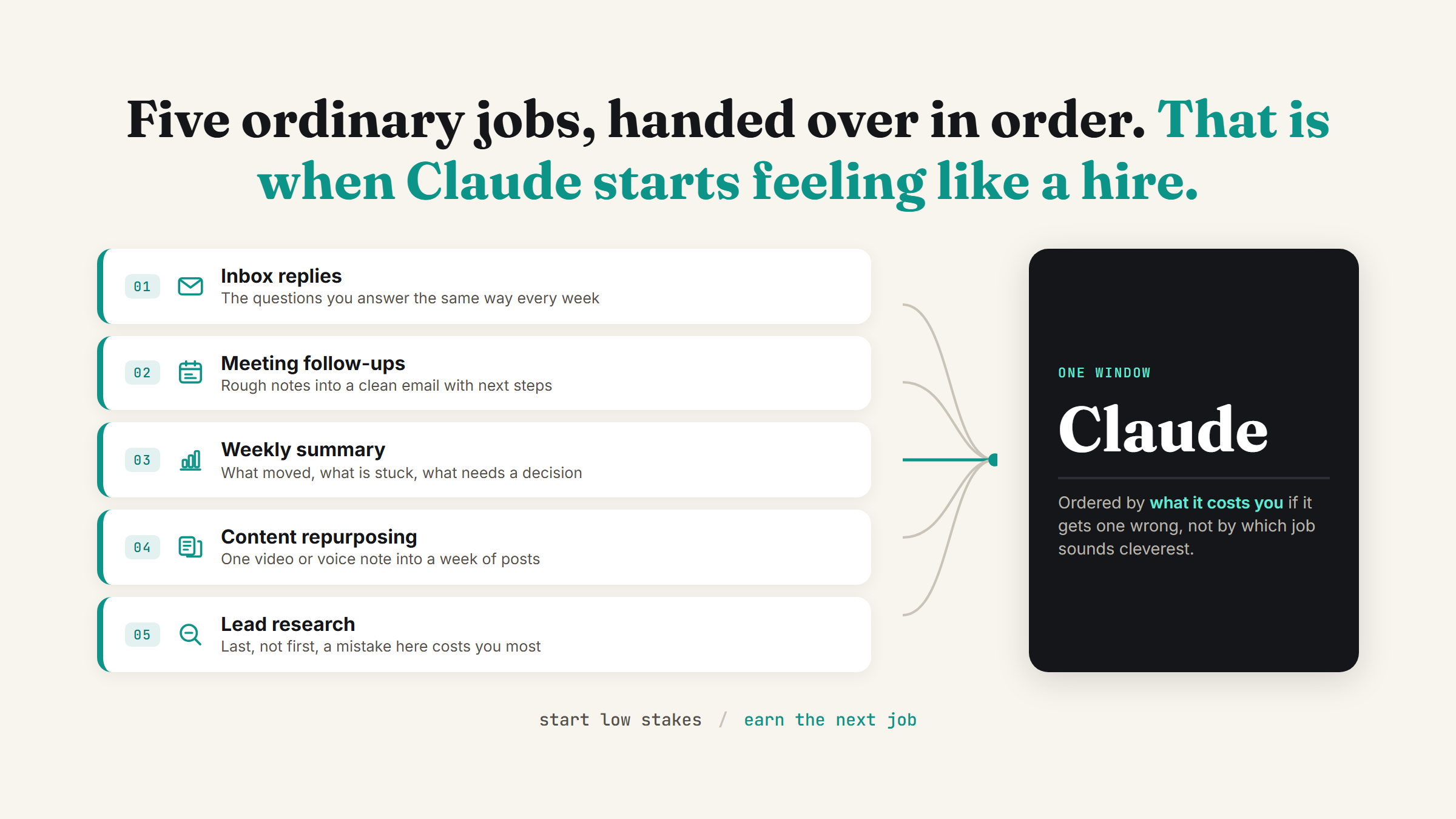
Once you've picked a task worth automating, the four decisions that turn a chat window into an actual AI employee, a narrow job description, tool access, a schedule, and a human checkpoint, are the same four decisions whether the job is inbox triage or a research scan. And if you're handling real client material, work through it without leaking anything private before you paste a single client document into a chat.
FAQ
Will AI replace consultants?
Not as a category. It's already doing the mechanical parts of consulting work well, research synthesis, first-draft structure, data cleanup, but the judgment calls, the client relationship, and the ability to structure an ambiguous problem from scratch stay with the consultant. The job shifts toward those parts, it doesn't disappear.
What consulting tasks can AI actually handle right now?
Research synthesis across interview notes or reports, first-pass outlines for deliverables and slide narratives, and cleaning up or restructuring messy data. These are the tasks that were always mechanical underneath the expertise required to interpret them, which is exactly why they hand off well.
What should a consultant never hand fully to AI?
Anything that requires owning a judgment call under ambiguity, structuring a genuinely unclear problem from nothing, or managing the trust relationship with a client. AI can lay out options and draft material, but it doesn't carry accountability for a wrong call, and it doesn't build the relationship that gets a consultant hired again.
How do I know which of my own consulting tasks to hand off first?
Pick the task that's most repetitive and most predictable, the one you do roughly the same way on every engagement with little judgment involved. A time audit of a real week will usually show you exactly which task that is, rather than you having to guess.
Want to know where to start in your own practice?
Book a strategy call and I'll help you map which parts of your consulting work are ready to hand off, and which ones stay yours.
Book a strategy call →One working AI system in your inbox, weekly
The Operator's AI: the email edition of everything I publish here, plus the Free AI Bundle the moment you join.
Subscribe free →