AI Training for Small Business Owners: What a Good Session Actually Covers
Search "AI training for small business owners" and you get course catalogues and webinar platforms selling a one-off session. A program that actually changes how a team works looks different. Here's the shape of it, from someone who builds and runs these.
 By Abi Odedeyi · CodeFreeIQ
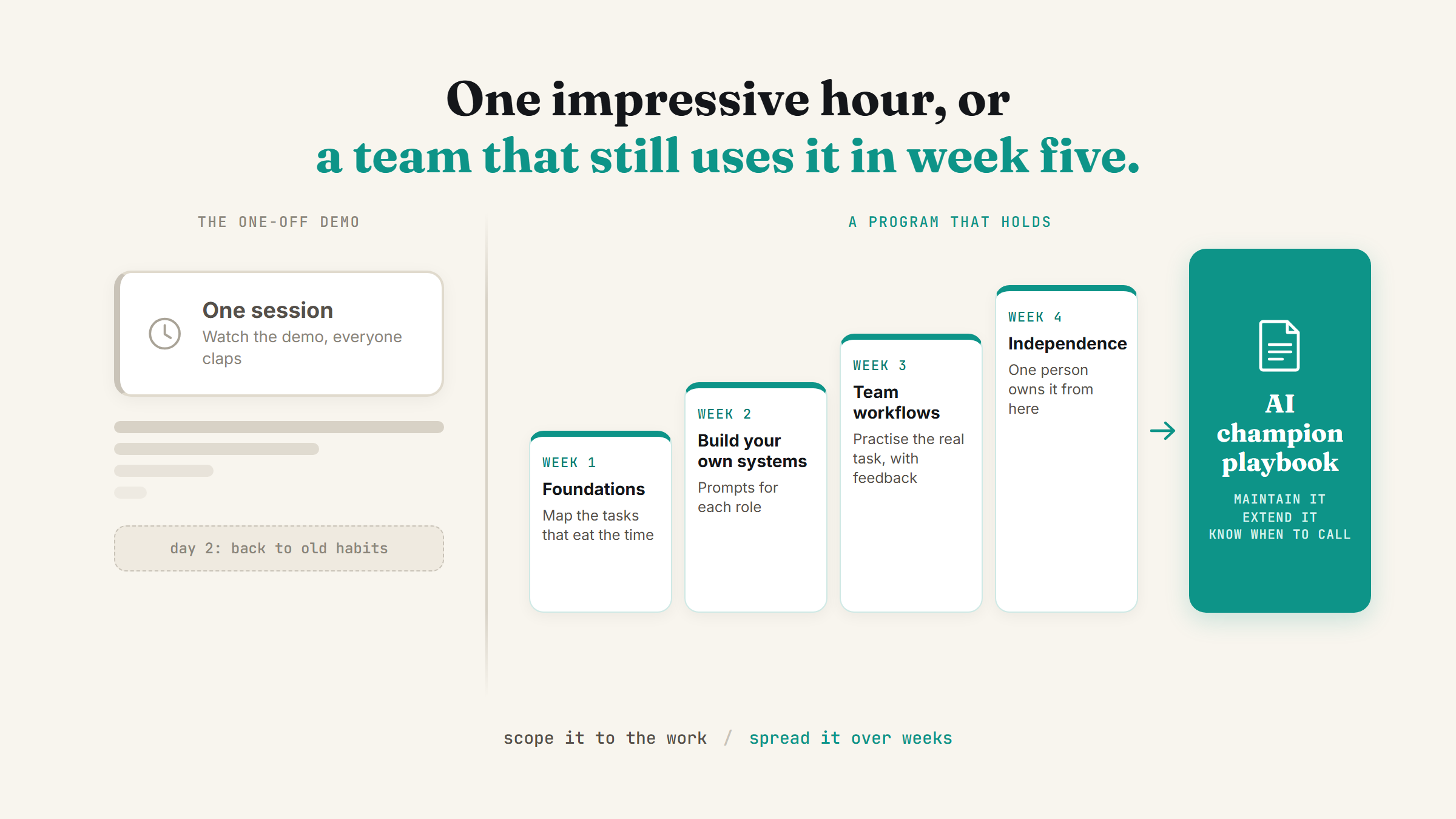
"AI training" gets sold as a single thing: book the session, watch the demo, everyone claps. I've run enough of these for small teams to know that format almost never survives past the Monday after. The team that actually changes how it works got something different: training scoped to the workflows they do every week, spread over enough time to practice between sessions, with a plan for what happens once the trainer leaves the room.
Why the one-off demo doesn't hold
A single impressive hour teaches people that AI is impressive. It doesn't teach anyone how to use it on Tuesday. Watching someone else draft a perfect email with AI, live, is a good demo and a bad lesson, because the team walks out having seen a skill rather than practiced one. By the following week, most people are back to doing the task the old way, not because AI failed them but because nobody built the habit.
The pattern repeats across the course catalogues and webinar platforms that dominate a search for this: polished, generic, and built for an audience of hundreds rather than a specific team of twelve with specific software and specific recurring tasks. None of them can tell you what your admin assistant's Tuesday actually looks like, which is the only thing that makes training stick.
What training that actually works covers
The shape that holds is role-specific, workflow-based, and spread over weeks, not crammed into an afternoon. Four things separate a program that changes behavior from a demo that doesn't:
- It starts from the team's real workflows, not generic use cases. Before anyone opens a laptop, the honest question is which five or six recurring tasks eat the most time: status reports, proposal drafting, follow-up emails, whatever is specific to that business. Training built around a generic "how to prompt ChatGPT" deck teaches a skill nobody can place anywhere in their actual week.
- Everyone gets prompts for their own role, not one script for the whole room. A sales lead and an admin assistant don't need the same fifteen minutes. Each person needs a small set of prompts built around what they personally do, not a one-size-fits-all cheat sheet that half the room can't use.
- It runs across multiple sessions with homework between them, not one sitting. A single hour can introduce a tool. It can't build a habit. Spreading the program across several weeks, with a small assignment after each session, is what turns "I saw that" into "I do that now."
- There's a handoff plan for after the trainer leaves. Training that ends with "good luck" quietly dies within a month. Someone on the team needs to walk out as the internal point person, with a simple playbook for maintaining what got built and knowing when a new problem is worth bringing in outside help for.
A fictional example: the same deck, two different outcomes
Picture two small accounting firms, each with eight staff, each booking "AI training" the same month. The first books a single two-hour webinar through a generic platform: a trainer demos ChatGPT, everyone nods, nobody opens it again. Three weeks later nothing in the firm has changed.
The second books a program spread across four weeks: the first session maps which tasks actually eat the team's time (client follow-ups and draft engagement letters, it turns out), the next two sessions build and practice prompts for exactly those two tasks by role, and the last session hands one staff member a short playbook for keeping the system running and for spotting the next task worth automating. A month later, draft follow-up emails take minutes instead of twenty, because someone practiced the exact task three separate times with feedback, not because they watched someone else do it once.
How to judge a provider before you pay for one
Ask what you'd actually walk away with, not what you'd watch. A provider who can only describe a slide deck and a Q&A is selling a demo. One worth paying for can tell you, before the first session, roughly how many sessions it runs over, whose job titles get their own material, and what document or system the team keeps using once it's over. If a provider can't name the specific workflow the training is built around, for your team and not a generic audience, that's the clearest sign it will land the same way a generic webinar does.
It's worth checking your own week before you shop for a provider at all. If you're not sure which task is actually worth building training around, a free AI time audit of your week will show you where the hours are really going, so the training gets scoped to something real instead of a guess.
What happens after the sessions end
The real test of training isn't the last session, it's week five. The handoff document matters more than any slide deck: a short playbook covering how to maintain what got built, how to extend it to a new task, and a clear line for when something is worth bringing outside help back in for, rather than improvising. I covered the same principle from the other side, building something narrow enough to actually keep running, in how to hire an AI employee and in do AI employees actually work: the setups that last are the ones with a clear owner and a clear scope, and training is no different.
Where to start
Don't book training for "the whole team on AI in general." Pick the one or two recurring tasks that are costing the most time right now, and ask any provider to scope the sessions around exactly those, with role-specific material and a plan for after the last one. The nine settings that turn Claude into your team is a reasonable place to start if you want the basics in place before any formal session, so the training time goes toward the actual workflows instead of account setup.
FAQ
How long should AI training for a small business actually take?
Longer than one session. A single sitting can introduce a tool but can't build a habit. A program spread across several weeks, with a short assignment between sessions, is what turns a demo into something people actually keep doing.
What's the difference between generic AI training and training built for one team?
Generic training teaches prompting as a skill in the abstract. Training built for one team starts from that team's actual recurring tasks, status reports, follow-up emails, proposal drafts, whatever is specific to the business, and builds role-specific prompts around exactly those. The second kind is far more likely to still be in use a month later.
How do I know if an AI training provider is worth paying for?
Ask what you'd walk away with rather than what you'd watch. A provider who can describe how many sessions it runs over, which roles get their own material, and what document or system the team keeps using afterward is scoping real training. One who can only describe a slide deck and a Q&A is selling a demo.
What should happen after the last training session?
A handoff, not a goodbye. One person on the team should walk out as the internal point of contact, with a short playbook for maintaining what got built, extending it to new tasks, and knowing when to bring outside help back in. Training that ends without that plan tends to fade within a month.
If you're weighing whether to book training for your team or figure out what to build first, book a strategy call and we'll scope it around what your week actually needs.
Want your team actually using AI by the end of it?
Book a strategy call and I'll walk you through what a program scoped to your actual workflows would look like, not a generic course.
Book a strategy call →One working AI system in your inbox, weekly
The Operator's AI: the email edition of everything I publish here, plus the Free AI Bundle the moment you join.
Subscribe free →